PRODUCT TESTING UPDATE
Indoor air quality is an important consideration when selecting insulation materials for residential, commercial, and other building projects. In addition to thermal performance and installation requirements, buyers may need information about the emissions characteristics of building products.
IKING stone wool has undergone volatile organic compound (VOC) emissions testing conducted by SGS-CSTC Standards Technical Services Co., Ltd., Guangzhou Branch. The test report provides laboratory results for an identified stone wool sample and includes modeled concentration assessments for specified indoor environments.
This testing provides technical information that customers can review when evaluating stone wool insulation for projects with indoor environmental requirements.
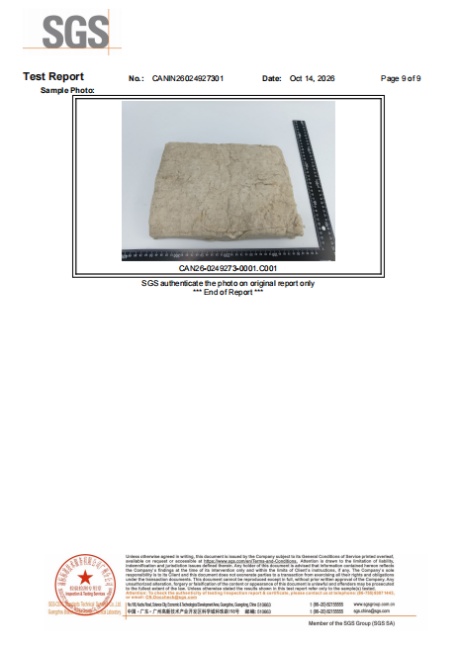
The test was performed by SGS-CSTC Standards Technical Services Co., Ltd., Guangzhou Branch. According to the report, the submitted sample was identified as stone wool, with the product specification recorded as 600 mm × 50 mm – 80K.
| Report Information | Details |
|---|---|
| Company | CHINA IKING INDUSTRIAL CO., LTD. |
| Test Organization | SGS-CSTC Standards Technical Services Co., Ltd., Guangzhou Branch |
| Report Date | October 14, 2026 |
| Sample Name | Stone Wool |
| Sample Specification | 600 mm × 50 mm – 80K, as recorded in the report |
| Testing Reference | California Specification 01350, Version 1.2, January 2017 |
The report includes chamber concentration results for total volatile organic compounds (TVOC) and formaldehyde at different sampling intervals. The results below are the reported chamber concentrations, expressed in micrograms per cubic meter (μg/m³).
| Sampling Interval | TVOC Concentration (μg/m³) |
|---|---|
| 24 hours | 159.3 |
| 48 hours | 90.4 |
| 96 hours | 90.7 |
| Sampling Interval | Formaldehyde Concentration (μg/m³) |
|---|---|
| 24 hours | 2.3 |
| 48 hours | 2.5 |
| 96 hours | 2.8 |
How should these results be interpreted?
These values are laboratory chamber concentrations recorded at the specified sampling intervals. They should not be interpreted as direct measurements of indoor air quality in an occupied building.
In addition to the chamber test results, the report presents modeled concentrations for selected compounds under specified indoor environment scenarios. These modeled results help provide context for evaluating emissions against the corresponding criteria.
The report's school-classroom scenario includes the following modeled concentrations and allowable concentrations for selected target compounds:
| Compound | Modeled Concentration (μg/m³) | Allowable Concentration (μg/m³) | Exceedance Reported? |
|---|---|---|---|
| Formaldehyde | 2.7 | 9 | No |
| n-Hexane | 2.6 | 3,500 | No |
| Toluene | 2.5 | 150 | No |
According to the report's evaluation table, the modeled concentrations of these listed target compounds do not exceed their respective allowable concentrations in the specified school-classroom scenario.
For insulation distributors, contractors, importers, and project procurement teams, emissions documentation can be an important part of product evaluation. Test reports provide technical information that can support discussions with project stakeholders and help buyers assess whether a material is suitable for their requirements.
VOC emissions are only one consideration when selecting stone wool insulation. Buyers should also evaluate relevant thermal, acoustic, fire-performance, dimensional, installation, and regulatory requirements according to the intended application.
Stone wool is used in a range of building and industrial insulation systems. Depending on the product specification and system design, potential applications may include:
IKING provides insulation product information for international B2B customers evaluating materials for building and industrial projects. If you are sourcing stone wool for distribution, construction, or project procurement, our team can help you review available specifications and discuss your requirements.
Contact us to discuss:
CHINA IKING INDUSTRIAL GROUP CO., LTD. glass wool factory was established in 1995 and is located in Tianjin. It is one of the leading glass wool supplier in China.....[ Read More >>]